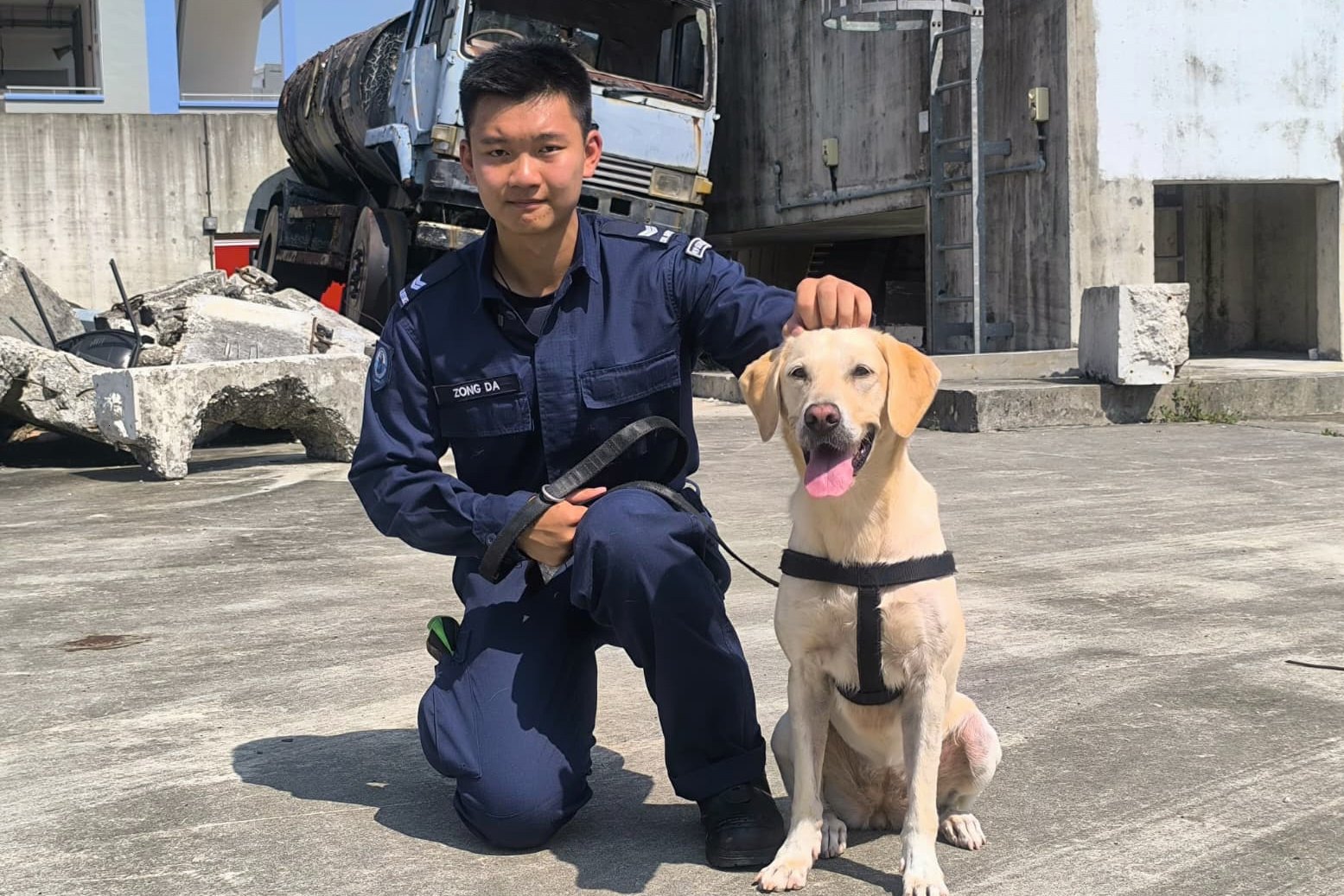
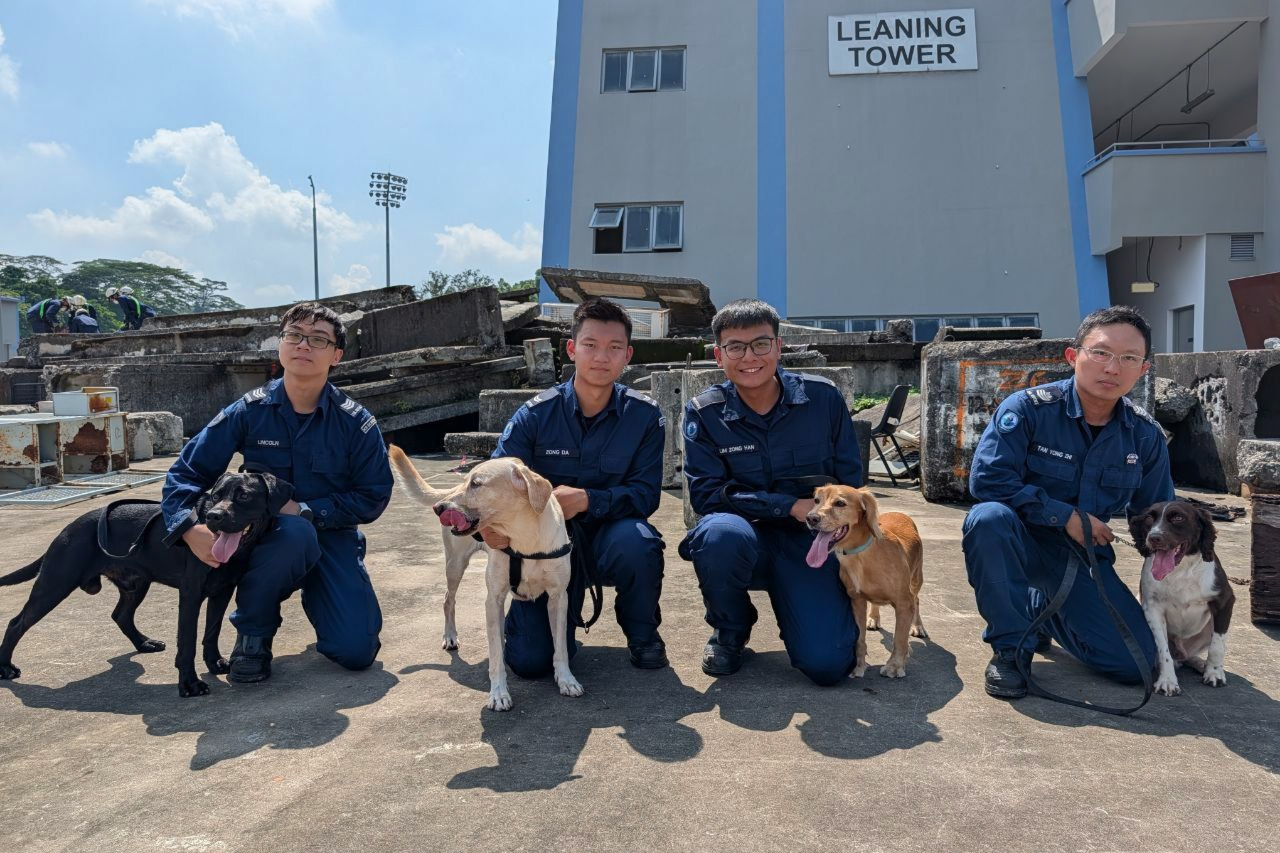
CPL She Zongda reflects on his journey in the SCDF Search Platoon, where trust, responsibility, and mutual understanding shaped not just how he trained, but also how he worked and forged deep connections with his canine partners.

For many full-time National Servicemen (NSFs), transitioning from Basic Rescue Training (BRT) to their assigned units comes with a period of adjustment. But for CPL She Zongda, a 20-year-old nearing the end of his National Service, joining the Singapore Civil Defence Force (SCDF) Search Platoon was more than a change in environment. It turned his lifelong love for animals into a vocation built on trust, patience, and love for his four-legged colleagues. Formed in 1997, the Search Platoon comprised regular officers, NSFs, and currently 17 dogs, which are trained in Urban Search and Rescue (USAR) or Fire Investigation (FI).
Zongda grew up with three Labrador Retrievers and now has a dog and two cats. When he completed his BRT, the Search Platoon felt like a natural fit for him. Upon being posted to the unit, he found a small, close-knit team of approximately 17 SCDF officers who enjoyed working with and caring for dogs. For Zongda, this marked the beginning of his vocation as a Dog Handler, a calling that required dedication not only to his work but also to the canine partner by his side.
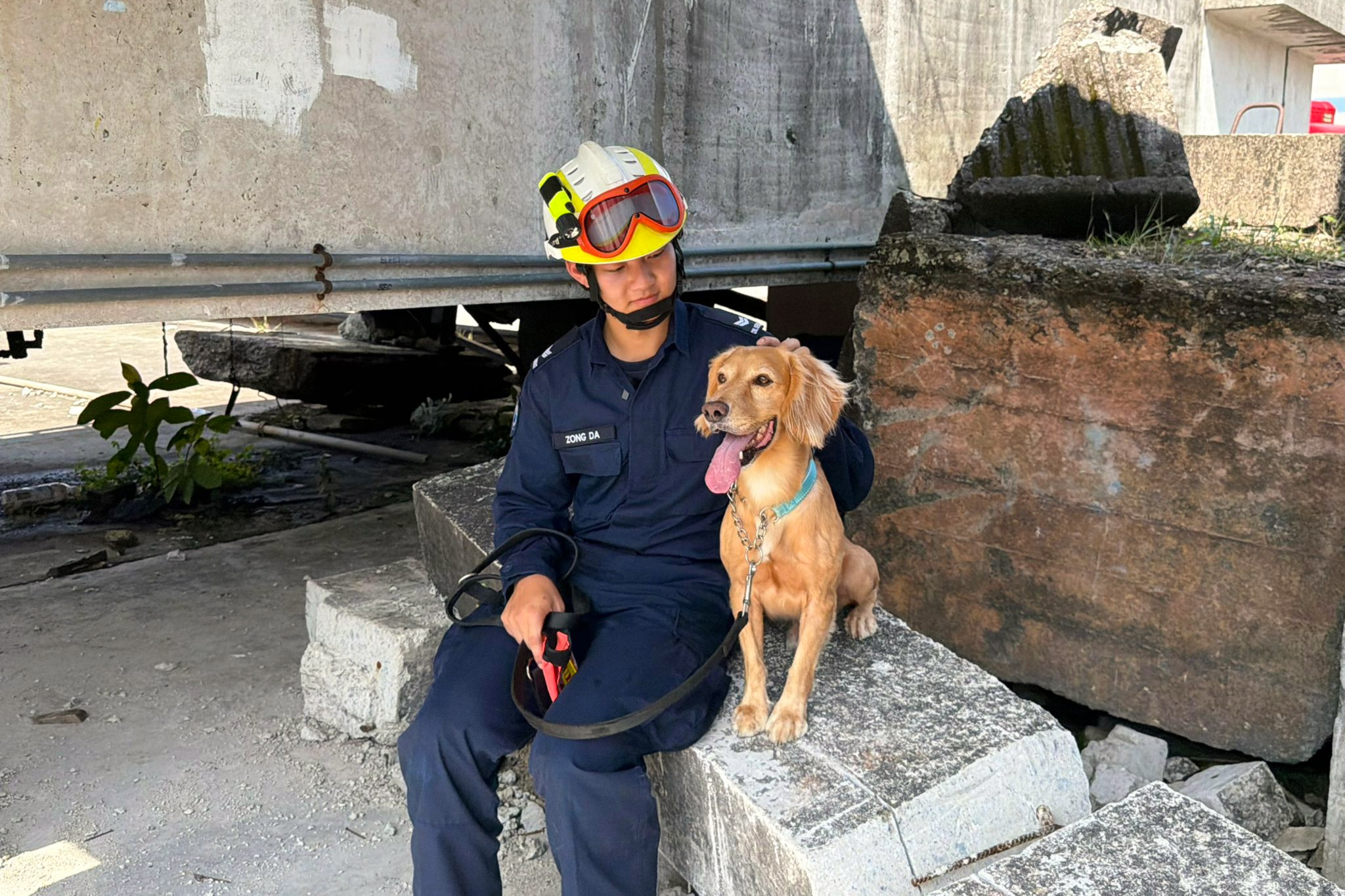
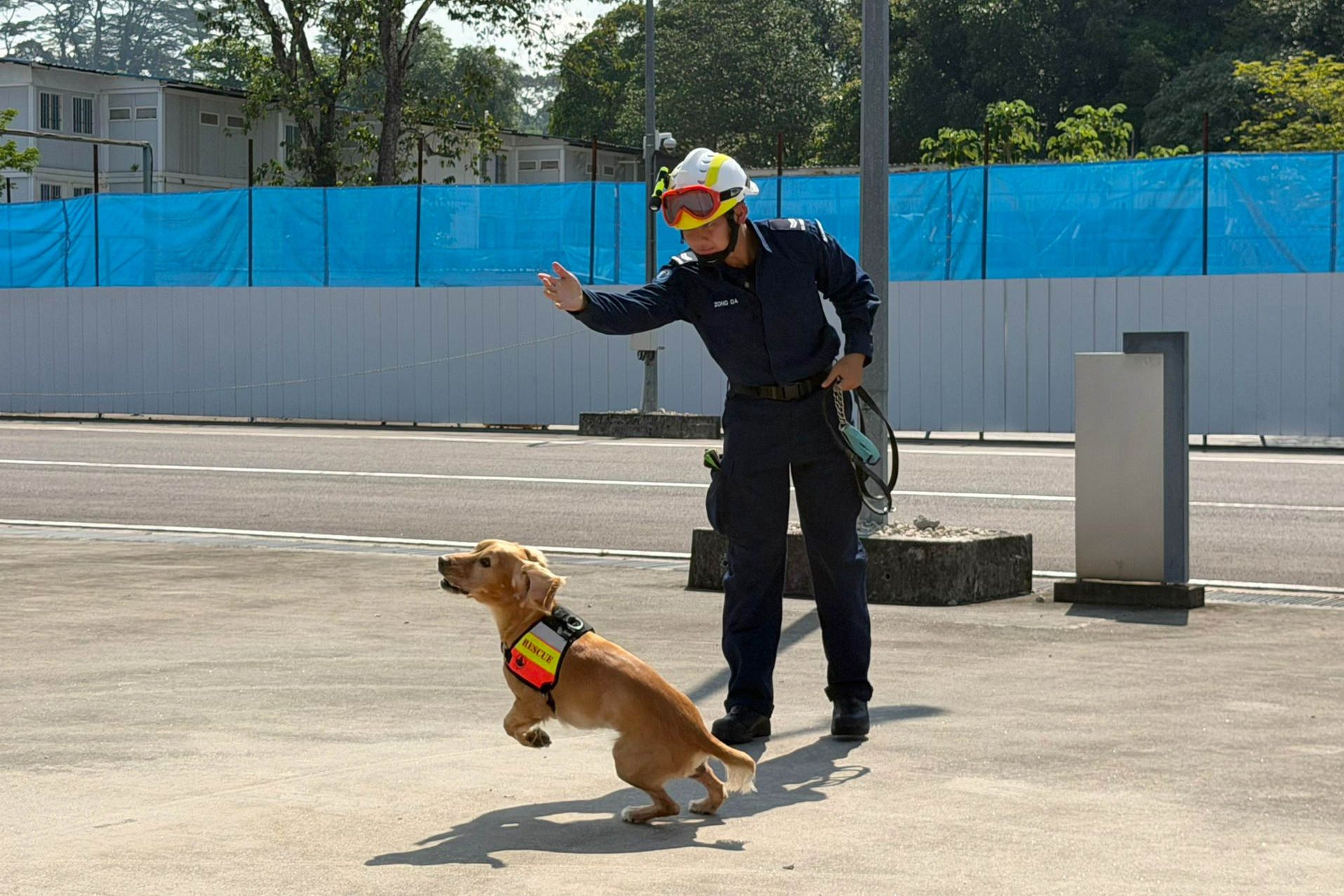
His first partner was Quince, a Cocker Spaniel specialising in USAR. Coming from a home with large Labradors, Zongda was initially struck by how small Quince was. However, his size belied his larger-than-life energy levels and personality. The energetic Quince would always be barking in excitement at the kennel gates the moment he sensed Zongda approaching.
As a USAR dog handler, Zongda realised that his vocation came with more responsibilities than being a pet owner. After getting to know Quince and his lively nature, he spent much time studying the best ways to manage Quince and more crucially, build a strong bond with him.
Other than teaching Quince basic obedience cues, Zongda would spend time petting him and scratching his belly every day. Once the bond was strengthened, Quince instinctively understood and responded to Zongda’s instructions.
Over time, Zongda’s dedication to Quince and his vocation became evident. Zongda would seek advice from regular officers on how to better train Quince. He tried out a “voice dragging” technique, in which he dragged out his commands in calm, measured tones, “relaaaaax, hooooooold”. He also learned to synchronise his walking pace with Quince to keep him focused when moving from point to point. With the help of his colleagues, Zongda achieved steady progress with Quince and felt a strong sense of camaraderie and support in the unit.
Training a USAR dog is a structured, multi‑stage process which taps on the dog’s natural instinct to hunt and play, honing its detection skills and reliability in the field. Channelling their natural instinct into consistent focus takes time and reinforcement. Zongda explains that for search dogs to succeed in USAR, they must have a strong drive to find survivors who are trapped under rubble, and be friendly enough to approach without alarming them.
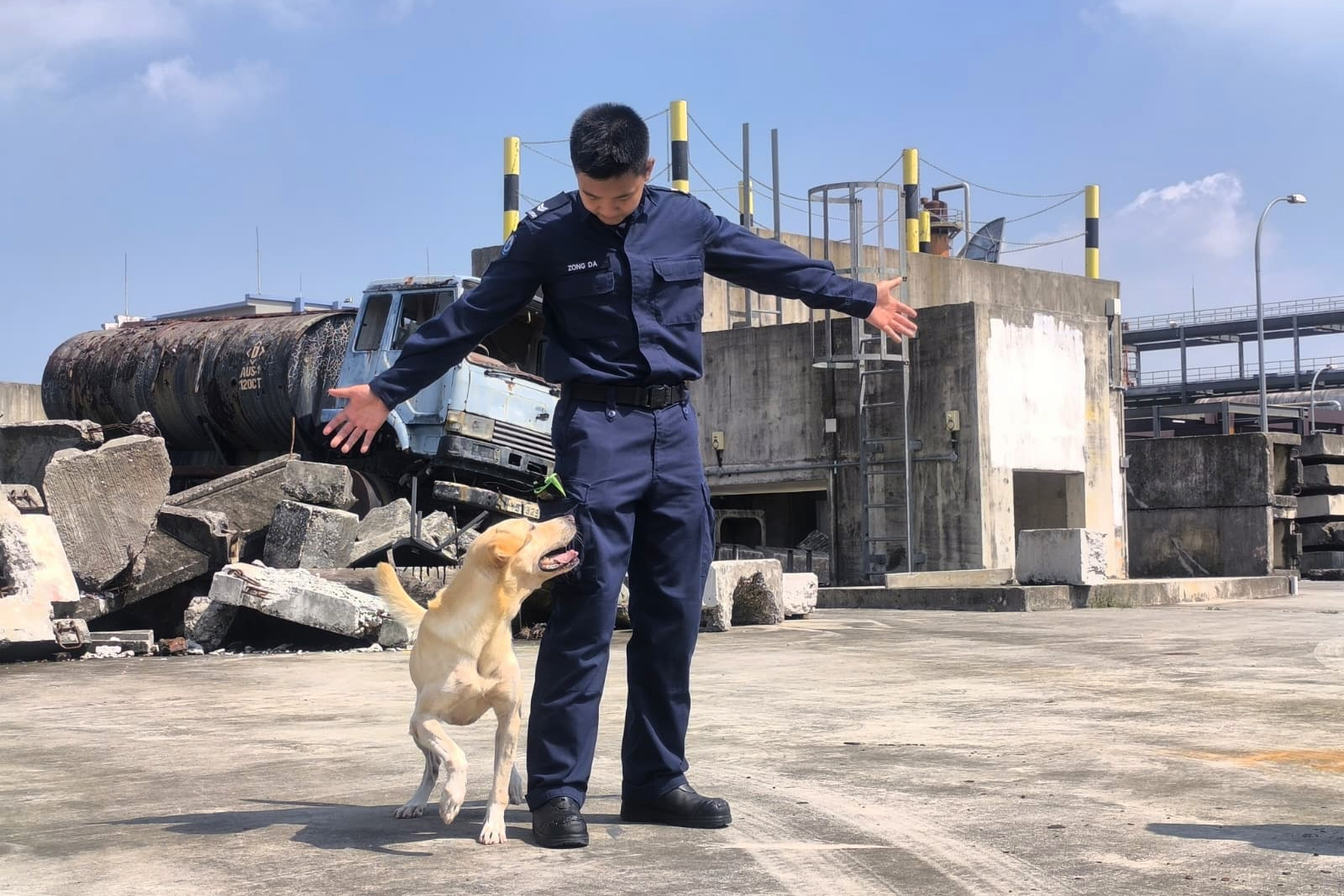
Training takes place in different phases at the Home Team Tactical Centre with facilities that simulate post-disaster environments, such as confined spaces and rubble.
Before training commences, the handlers will don their Personal Protective Equipment and conduct safety checks of the area. A colleague will hide in the rubble as a simulated “casualty” for Zongda and Quince to locate. Conversely, when another team is training, Zongda would take on the role as the “casualty”.
By simulating various scenarios under the handlers’ strict supervision, it reinforces the dogs’ innate drive to search for “casualties” swiftly and confidently.
After Quince was handed over to a mentee, Zongda began working with Sophia. As a Labrador specialised in Fire Investigation, Sophia works with fire investigators to detect traces of flammable liquids after a fire incident. Like Quince, Sophia is highly intelligent but expresses herself differently. She is attuned to human emotions in a calm and quiet way, unlike Quince’s exuberance and playfulness. She is also highly agile and nimble when running around the training grounds.
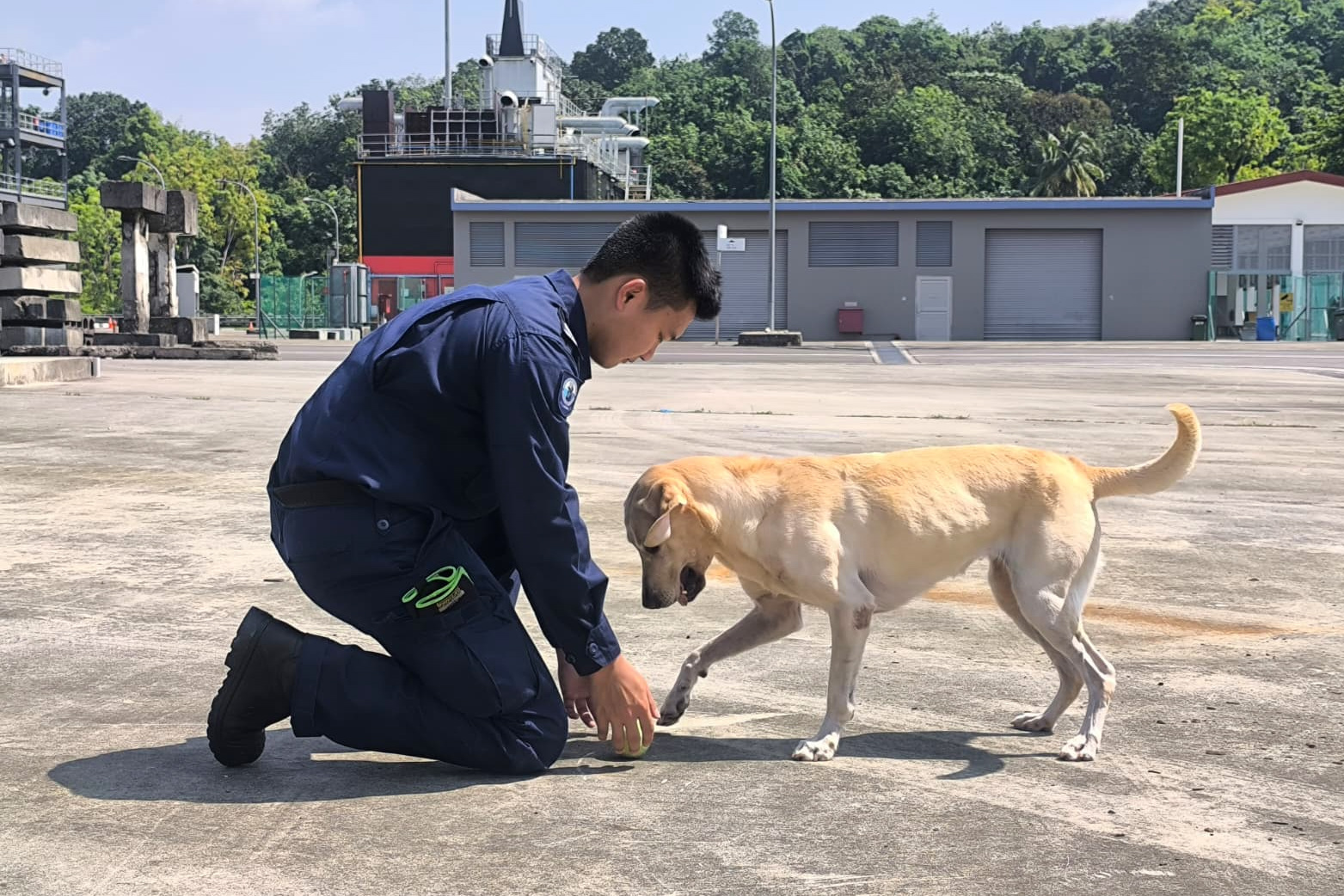
Handling Sophia was different. Fire investigation dogs must be methodical, covering the entire fire scene systematically to detect hints of accelerants like petrol, diesel, or acetone. While USAR dogs are trained to bark upon detection of a human scent, Sophia is trained to “freeze” on the spot when she detects an accelerant.
When rewarding Sophia, Zongda has to be extra careful. To keep her focused on the scent source rather than on him, he throws the reward ball from behind her back. And just how much accelerant is applied for Sophia to pick up the scent? “About 50 micro-litres, which is one drop, sometimes even less,” says Zongda.
As Zongda’s understanding of his search dogs grows, both Quince and Sophia have also become incredibly sensitive to his mood. Even when Zongda is feeling down, he makes a conscious effort to keep his spirits up. Nevertheless, Quince and Sophia would pick up his emotions quickly and try to cheer him up.
Reflecting on his experiences in the Search Platoon, Zongda shares that it has turned him into a “better pawrent” to his pets. He now has a better understanding of their behaviour and the importance of meaningful playtime.
For Zongda, the SCDF Search Platoon was more than a posting. It was where he acquired a professional ethos, putting in the hours and energy to sharpen his partners’ skills. As he will be heading to the University of Chicago to study sociology soon, Quince and Sophia will remain his close partners in his memories. To Zongda, the duo are not just dogs. They are highly capable individuals that help SCDF to fulfil its mission as a lifesaving force.
Like our stories? Subscribe to our Frontline Digital newsletters now! Simply download the HomeTeamNS Mobile App and update your communication preference to ‘Receive Digital Frontline Magazine’, through the App Settings.